
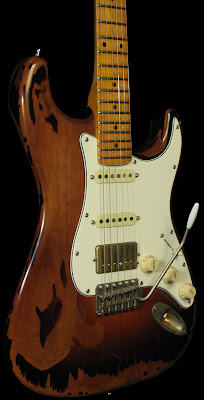
 Just a few months after starting to play the guitar, I read a line in an article saying something like, “the Gibson Les Paul is a rite of passage for guitar players.” I also remember hearing the old saw, “the Les Paul and Stratocaster need no improvement as they’re the pinnacle of electric guitar design.” But even before I truly understood what makes a good guitar, I knew these statements were suspect. I also noticed very few “high quality” guitars other than Gibsons and Fenders whenever I’d walk into any given music store. PRS guitars, whose most popular model combined the shape of both guitar models in question, tended to occupy the remaining space. I figured that surely, at least one other company had to make a more well-designed product than the oldest and largest electric guitar manufacturers in the United States.
Now, after years of playing, buying, and building guitars, I realize that my instincts were correct. Gibson and Fender make the same guitars they introduced in the 1950s, and very little has changed over the years. In fact, other manufacturers take these designs and improve their functionality. For example, they eliminate the overly large neck joints of the Les Paul and Stratocaster and beef up the stability of their necks with multi-piece construction. Since people still flock to the local Guitar Center to empty their wallets for the two oldest and most unchanging designs in the history of electric guitars, we should examine why this is the case and then discuss the guitar industry’s need to move forward.
In all fairness, I’m not surprised that the Les Paul and Stratocaster dominate the world of electric guitars because they were among the very first electric guitars on the market (introduced in 1952 and 1954 respectively), so they’re well rooted in ways other guitars aren’t. For example, Kramer, the famous peddler of hair metal’s guitars, rose monumentally in the 1980s. In those days, music stores didn’t sell electric guitars if they didn’t have Kramer. But then Kramer went belly up in 1990 due to management issues and because its image was tied too closely with big hair. Essentially, Kramer was a fad. The Les Paul and Stratocaster had already immortalized themselves, having been here since the beginning.
The Les Paul’s and Stratocaster’s manufacturing history tells how the models might not have changed with time. The guitars made from the 1950s to the mid to late 1960s remain the most well respected from both brands. In 1965 Fender Electric Instrument Company was sold to the Columbia Broadcasting System. And in 1969, Ecuadorian Company Ltd. acquired Gibson’s parent company, Chicago Musical Instruments. Gibson again changed hands in 1974 when taken over by Norlin Musical Instruments. The quality of Gibson’s and Fender’s products fell due to management cutting corners. Both Fender and Gibson experimented, especially during the 1980s, but the lack of quality craftsmanship no doubt damaged the credibility of the more experimental models. This unique situation could very well explain the over-glorification of the approximately sixty year old designs and the numerous reissue models from both companies that refer to the 50s and 60s.

- The 3 piece neck of an Aria guitar. This also displays the traditional Fender style neck joint.
While largely dated at this point, the Les Paul and Stratocaster did provide a fine starting point in electric guitar design, but just a starting point. For instance, Most Les Pauls and Stratocasters come standard with flat-sawn one piece necks. Accordingly and by necessity, competitors like Carvin and Ibanez have improved on the original designs by offering multi-piece necks. Carvin’s familiar Les Paul and Stratocaster designs offer five-piece necks as an option. And Ibanez, with its “Superstrats” (a term for hot rodded Stratocasters), offers three- and five-piece necks very widely among its product base. Gibson also used three and five piece necks on many models throughout the 1970s and 1980s. A multi-piece neck allows the builder to oppose the grain of the separate pieces. These sturdier necks remain less affected by changes in humidity and temperature and require less maintenance. This not only provides a large benefit to touring musicians, but also to average players, by reducing maintenance costs. Although this neck design adds a few steps to the process of manufacture, the modern manufacturing process easily accommodates them.
While the benefits of a multi-piece neck are most preferable, the very least that Gibson and Fender could do is offer quarter sawn lumber as a standard feature instead of flat sawn lumber. Quarter sawn lumber provides protection from humidity and such, but the effect isn’t quite as drastic as multi-piece neck design. However, considering the price and standing of the Les Paul and Stratocaster, any reasonable person would expect Gibson and Fender to at least make an effort to match competitors’ efforts.
Another glaring inadequacy from which the Les Paul and Stratocaster suffer has to do with the humongous neck joints. On both designs, the neck meets the body at the sixteenth fret. To say the least, the Les Paul and Stratocaster were not designed with the soloist in mind. To remedy the Les Paul’s issue, Carvin uses deep set necks on their Les Paul shaped models. On most Gibson guitars, the neck ends with the fret board, but Carvin’s necks extend beyond the fret board by five inches for increased stability. And because the necks are set deeper, Carvin may safely shave the neck joints down for much easier access to upper frets. Gibson even offers a few Les Paul models with a similarly deep set neck such as the Gibson Custom 1960 Les Paul Standard, but Gibson doesn’t even take the opportunity to shave down the neck joint.

- The contoured neck joint of a Fender Stratocaster Deluxe.
For unobstructed access to the end of the fret board, many makers of Superstrats contour the traditional blocky Fender neck joint. The most common technique is the tilting of the back of the neck joint to make it less obtrusive. Companies like BC Rich, Hamer, and Warmoth employed the popular tilted neck joint. Fender sometimes pitifully tries by shaving of a small amount of wood from one corner.

- The Stephen’s Extended Cutaway on a Washburn N4.
The most extreme and successful examples of the contouring of the Fender style neck joint are Ibanez’s All Access Neck Joint (AANJ) and the Stephen’s Extended Cutaway used by Washburn. The AANJ uses a gentle arch which curves more deeply where the player’s hand rests instead of the traditional blocky square shape. The AANJ also tilts like its predecessors, but features no sharp corners. The Stephen’s Extended Cutaway eliminates the obtrusiveness of the Fender joint almost entirely. It employs five bolts along a curve instead of four in a rectangle. Fender continually fails to keep up with the competition, but not that the public would know.
My journey to find the best guitars has me evaluating much more than basic construction. But the Gibson Les Paul and Fender Stratocaster don’t appease me on that basic level. If someone drops thousands of dollars on an instrument, I hope that person gets something truly exceptional. Gibson and Fender aren’t entirely to blame, however. Both companies gave an honest effort to innovate. I personally like the Kahler equipped Les Pauls with multi-piece necks and Fender HM Strats of the 80s. Unfortunately, their periods of design innovation coincided with times of poorer craftsmanship. The public probably wrongly associated new models with incompetent assembly and continued to fantasize about the quality (if archaic) guitars of the 50s and 60s. In the end, I can’t in good conscience endorse the Les Paul and Stratocaster when other companies offer similar designs, but with the issues ironed out.


Your knowledge on this subject is monumental. I had always assumed that Stratocasters and Les Pauls were the only two real guitar companies out there. I also assumed that those companies knew what they were doing. I intend to share this article with several of my musician friends.
Thanks, Jonathan. I wouldn’t go so far as to say my knowledge is monumental, but I’m confident in what I know. Guitar players need to think objectively about their guitars. It’s kind of like forcing a kid to hold a pencil a specific way. It’s best to just let him find what’s most comfortable. Many guitar players limit themselves by thinking that the Gibson Les Paul and Fender Stratocaster are the only two options.
I’ve played guitar for a while now and never owned a Fender or a Gibson, but the electric I own does make it a bit difficult to hit the high notes. The next time I shop for a guitar, I will look for a model made with these things in mind. Great article.
The Strat and Les Paul sounds are different personalities, but I’ve always liked them both. I remember some Ibanez models as having a pretty flashy sound. I can’t place the Washburn N4 sound at all.
Both Les Pauls and Strats can sound great even for extreme metal, which is my area of expertise. Rob Barret (of Malevolent Creation, Solstice and Cannibal Corpse) has used Les Pauls for years and the same with the guys from Obituary and Strats.
I like the sound of Ibanez guitars. The pronounced mid range of basswood makes for a very nice sound. But I’m a bit sad to have never sat down with a Washburn N4.
I had no idea about the severity of the situation. Similar to Jonathan I was ignorant in prescribing to the masses obsession with Fender and Les Paul. I remember years ago when my exchange student first arrived, the first thing on his list did not consist of the Grand Canyon or New York, but he wanted to buy a Gibson Les Paul Custom. His preference ran him a hefty 1,800 dollars or something of the sort. Ultimately, people’s pack mentality and greediness exposes an interesting angle. One question someone may ask is, “Would people still be in love with these classics if they changed them?” I feel as though people’s reluctance to change would hinder them in making a decision to do just that. Not very many people find comfort in fashion forward like decisions, rather maintaining the status quo can easily sooth a consciousness. In terms of greediness, why break what works (or in this case sells)? I feel as though the original starters of the company would be sickened by the direction their companies have taken. Instead of following their vision, major companies bought out their companies who focused on selling product which eliminated passion from the equation. In the end the corporation owners do not have incentive to reinvent the wheel when the square one is selling just fine.
Gibson was actually very progressive in the 50s and 60s. After the Les Paul waned in sales, they came up with many new models: the SG, Flying V, Explorer and Firebird (which actually featured a 9 piece neck). The SG was originally designed to be more of a soloist’s guitar. The body met the neck at the 19th fret (as opposed to the 16th) and the neck was thinner. And the Firebird was one of the first production guitars to feature neck-through design. This is where the neck runs the full length of the guitar and the rest of the body is glued onto the sides of the neck. There’s no need for a large neck joint at all. You’re definitely right that the original owners of Gibson would not be pleased with what’s been done with the company.
Excellent, informative, and a bit nostalgic even for someone who didn’t grow up in the era. I’m listening to some Hendrix as I read your article and reply, and it’s unsurprising that these guitars have become enshrined in our culture. That said, I appreciate your telling us what to look for in guitars should we choose to invest in high quality. The Ibanez tips are good, as they’ve attained a phenomenal reputation (helped no doubt by Mr. Vai) but I would like to hear more about makers that do it right. Is there any genuine design innovation going on in the guitar world? Dean comes to mind, but that’s mostly cosmetic…I’d like to hear more about the manufacturers who are doing it right.
I was very tempted to knock endorsements, but Steve Vai’s partnership with Ibanez led me to not do that. His partnership with Ibanez led to the first mass produced 7 string guitars (the Ibanez Universe) and the JEM series. And I personally think that Carvin is my favorite mass manufacturer nowadays. Every 6 months or so, they seem to have a new model. Carvin has a very wide selection, but my favorite model of theirs right now is the Allen Holdsworth headless guitar. They also offer eletric guitars with piezo pickups and MIDI. Although, I don’t know how many other guitar companies do that.
Both guitars have stood the test of time, but i have played and owned both guitars and i find that the les paul has more beef and guts for the style of music that i prefer. With that said, I now own a gretsch guitar and it inspires me everytime I play it. It’s great for every style that I am interested in. The key is finding a guitar that inspires you and makes you want to play it.
I definitely agree that the Les Paul and Strat designs are outdated, in the interior and exterior, but I don’t think that will ever change. My grandpa gave me his old Strat and I still love playing it, but personally, I’d rather go with my Jazzmaster or an SG. Fender has and always will be my go-to company, whether it’s for nostalgic or tonal reasons.