
Meme’s the Word

The scientific revolution spawned by The Origin of Species is now morphing in ways Charles Darwin himself might not have expected, as the principles of adaptation and natural selection are manifesting themselves in fields far removed from biology. Most notably, when applied to human thought, culture, and institutions, the theory of evolution becomes the discipline of memetics. A meme is a concept adept at replicating itself within human brains and influencing human behavior. Memes, like genes, can combine with each other to create informational superstructures. Systems of memes take on a life of their own, controlling and influencing the behavior of millions; preserving themselves at all costs; and competing for cranial dominance with other memes and meme-systems.
With the memetic model, humans can finally begin crafting cogent explanations of global culture and making predictions of how culture will evolve in the coming century. Memetics can explain why blatantly false ideas can garner enough votes to win an election. It can provide a reason behind horrible cultural practices, such as honor killings of wives and sisters by the Taliban, wherein the memes are preserving themselves at the expense of their human hosts. It can demonstrate how the presence of Jesus within the mind can be an effective therapy for treating alcoholism and addiction, and how that presence can also inspire people to burn others alive for the memes they carry.
The study of memetics also changes the way we think about thinking. All revolutions and paradigm shifts evoke fear and derision, of course, and the resistance from all sides to meme theory demonstrates its potential power. The emerging discipline of memetics will take the humanities and the social sciences by storm, with the potential to be the killer-app of the 21st century.
To date, meme definition inspires heated debate. Some relate them to mind viruses, ideas that spread from person to person like the flu. Originalists keep to biologist Richard Dawkins’ first definition, that they are units of culture similar to genes. This distinction, as may already be apparent to some, is wholly arbitrary. Genes form the building blocks of viruses. In fact, viruses are the simplest imaginable carrier for genetic information, so basic there is still debate as to whether they are actually living creatures.
Genes, by themselves, cannot do anything. They are nothing more than carriers of information. When they come together, however, they begin to act on their environment. In the case of viruses, they insert themselves into an existing cell and hijack the cell’s machinery to make more copies of themselves. In the case of human beings, they provide the recipe for the entire body, as well as the basic instincts to feed the body, protect the body, and of course to copy the genes to another body.
The core notion here is replication. Genes that are good at making copies of themselves become widespread–those that aren’t eventually disappear. New genes are formed when two partners trade and combine their genetic information, or when a copying error arises that happens to be useful. Contrary to popular belief, mutation is not the driving force behind evolution; that honor belongs to sex, which makes a new mixture of genes every time it is successful.
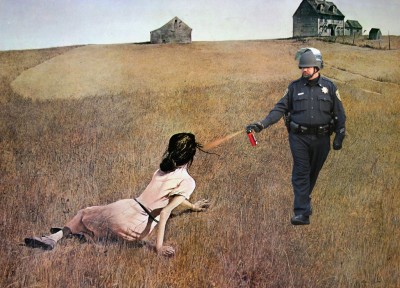
Occupy Wyeth
The aforementioned metaphor is, of course, one of many interpretations of the meme. To the layman, a meme is a well-known photograph accompanied by a semi-original and maybe-clever caption. To many biologists and neuroscientists, a meme is nothing more than an unfortunate metaphor, a neologism coined by Dawkins back in ‘76 that got picked up and blown far out of proportion. To an anthropologist or an historian, a meme is yet another invasion by materialists and scientific reductionists into the hallowed ground of art and culture.
When Dawkins invented (or discovered) the meme, he intended it to be a metaphor for how genes behave and express themselves in the natural world. The study of genetics forms the foundation of modern evolutionary biology, allowing scientists to trace the history of life on Earth back to the very beginning. Giving a concrete basis to Darwin’s theory of adaptation and natural selection, genetics has tremendous power to explain life as we know it and to make predictions about future discoveries. The theory of evolution has never been wrong, though it has been mistreated and abused by supporters as well as detractors, and it continues to provoke marvelous insights and discoveries.