
Confessions of a Derby Dame
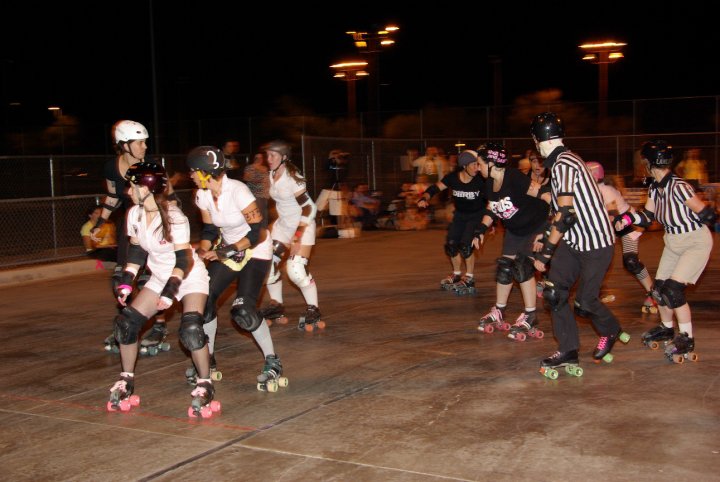
I could hear the wheel bearings of my skates spin with each revolution as I smiled at my friends and watched them take their seats. I tried to project the appearance of calm experience and a confidence I didn’t feel. I knew enough about my competition to understand that if I showed even a hint of uncertainty, they would pick up on it, converge on me when they knew the time was right, and show no mercy.
Just a few months before, I was on the sideline, a nameless face in the crowd, part of a cheering, screaming mass that watched in awe as the women on the track dazzled us with the speed of their skating and the ferocity with which they hit. Now I was ten minutes away from my first official bout and the newest jammer on the top-ranked team in our league. My job was to score points. The only way to do that was by making my way through a group of opponents whose main priority was to stop me. Those players would try to knock me to the ground, push me out of bounds, and generally demoralize me, all while skating at breakneck speed around a track as slick as an ice rink.
The physicality that derby presented was not a concern for me because I had been involved in so many contact sports as a child. In fact, it seemed the more challenging the activity, the better I performed. The truly frightening thought, the one that I couldn’t get out of my head, was that I didn’t have the charisma to pull this off. All the skaters around me had one thing I didn’t — a larger than life derby persona. Regardless of who these women were in their homes or at work, when they got on this track, the crowd knew them as Polly Graf, Bolshe Vixen, All Night Dinah, and so on. They were the good guys, the bad guys, the girls you love to hate. I didn’t know how I would fit in to this bizarre and beautiful circus.
At that moment on the track, just minutes before the bout, I made the decision to approach roller derby like every other sport in my life. Knowing that I had done the work to prepare, I put on my game face and flipped my switch. I pushed the thoughts of performing for the crowd out of my head and floored it. It wasn’t until after the third lap that I realized my team had fallen in behind me. Not certain how long I was expected to keep the pace, I stretched out my legs and tried to keep an even, measured stride. From behind me I heard a familiar call from our captain, Deadlock Doe, “Order up!” That was my signal. I looked over my shoulder to gauge the speed of the skater headed towards me. I counted the seconds between her crossovers, and just as she broke to my right, I swung in. THWACK! The sound of our bodies smashing together could be heard across the track. A hundred pairs of eyes turned to watch as we fought to control a small slice of the track. Suddenly, the smile on my face was genuine.
Fast forward to ten years later, and I found myself a spectator again. As I watched the WFTDA (Women’s Flat Track Derby Association) championships last November, I was filled with a bittersweet pride. I was impressed with the level of athleticism that each team displayed and the professionalism of the referees and tournament staff. This was a far cry from the dirty warehouse style venues I had played in ten years ago. There were no catfights, no cheap shots after the whistle, no penalty wheel with categories such as pillow fights or backward jams. Roller derby was now a legitimate sport, and I wanted to be a part of it.
I can admit now that my feelings of jealousy were not fleeting, and I continued to revisit that first season in my mind long after last year’s champions were crowned. I found myself looking through photographs wondering again and again, what if? What if I had stuck with it another year or two? What if I hadn’t been introduced to derby until it had worked through the awkward growing pains of an “alternative” sport? Could I have been a team USA star, helping to push my sport towards the Olympics? The answer, honestly, is no. The truth of the matter is, I never felt as passionately about derby as most of my teammates.
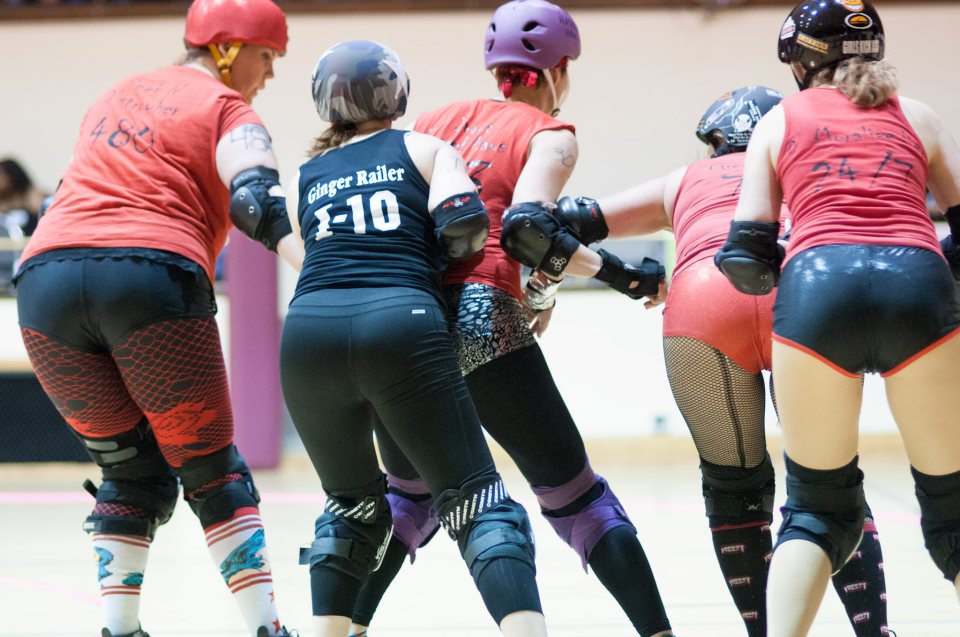
It feels good to admit that openly. Even in writing these words, I have to consider whether or not this is something of which most people are aware. Two big differences separated me from many of the women I skated with. First, several of my teammates lacked experience with athletic competition in general and, more specifically, contact sports. Considering the amount of cooperative training and physical closeness that are mandatory in the game of roller derby, it was a shock to me that so many skaters had absolutely no history in traditional team sports. What was the common thread drawing all these ladies to such a demanding and little-known activity if not the familiarity of athletic competition? This question led me to the second and possibly more crucial difference — that most of the people attracted to derby were there for the lifestyle and social circles it represented, not for the actual sport. There was such a fundamental difference in the reason I wanted to participate that as I look back on my career, I’m still surprised I lasted as long as I did.
It’s important to point out that I succeed in athletics not because of a superior amount of talent or coordination, but because of a tenacity and commitment that I don’t always see in other people. I don’t know where this part of me comes from. My parents didn’t push me into sports. I was given the freedom to pursue whatever interested me as a child, whether it was reading books in my room or climbing the trees in our neighbor’s backyard. As I grew older, I found that I couldn’t really be happy if I wasn’t involved in some kind of extracurricular recreation. I loved learning and usually did well in class, but I often found myself counting the minutes left in each school day, waiting restlessly for the opportunity to run outside. It wasn’t until I had reached my teenage years that I noticed the reason for my excitement had nothing to do with who I was spending time with, but rather what I was spending time doing. I wanted to push myself and see how fast I could run and how strong I could be, and it was purely coincidence that these things usually involved others.